 Your mouse pointer like everything else in your computer is configurable. One of my favorite and often forgotten tweaks for you mouse, is modifying the speed at which the cursor moves on your screen. If you’re mouse area is confined it helps to have a fast speed, which keeps you from moving your mouse so much and gets you across the screen without having to lift your mouse. However if you sometimes have difficulty following your cursor or use programs like Photoshop and Corel Painter to draw without a tablet, slowing down your cursor on the screen could make it easier for you to work on your computer. Regardless of what you like or do on your computer, it boils down to how you feel comfortable, so follow the steps below, play with the speed setting and find the configuration that works for you. Below you will find the steps necessary to accomplish this. As always comments/suggestions are welcome.
Notes – Via Microsoft Help
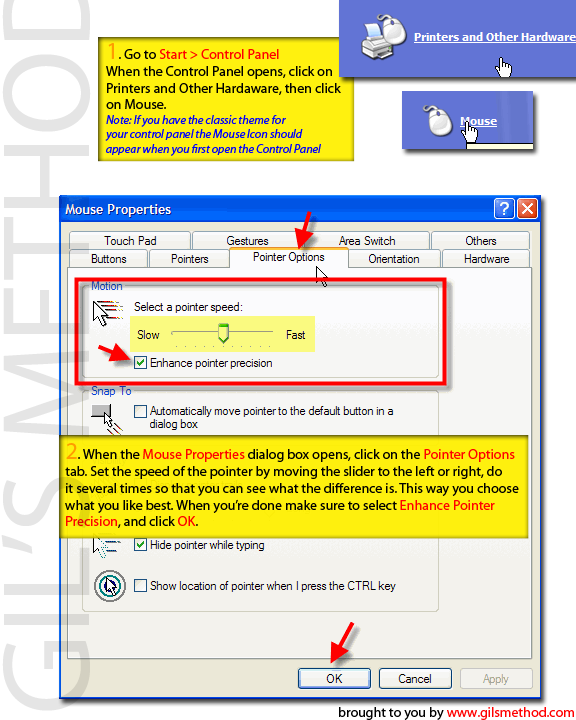
*To open Mouse, click Start, click Control Panel, click Printers and Other Hardware, and then click Mouse
*Adjusting the speed of your mouse pointer causes the pointer to respond more quickly or slowly to the movements of the mouse itself.
*Select the Enhance pointer precision check box to provide finer control of your pointer at short distances without losing the ability to move the pointer quickly across the screen. Clear the check box to turn off this feature.
*You can have the mouse snap to default buttons (such as OK or Apply) in dialog boxes by selecting Automatically move pointer to the default button in a dialog box under Snap To.
1. Go to Start > Control Panel
2. When the Control Panel window opens, click on Printer and Other Hardware, click on Mouse (if you’re using the classic theme for Control Panel, click on Mouse)
3. When the Mouse Properties window opens, click on the Pointer Options tab.
4. Under Motion you will see a speed slider that ranges from Slow to Fast, slide it back and forth, trying it out at each interval.
5. Make sure that Enhance Pointer Precision is selected (read above for notes on this feature).
6. When you’re done, click OK.