
Get Around the Windows 7 Start Menu
Since we began our first guide using the Start menu to access the Shut down, Log off, and other commands, it’s only right that we continue to explore the Start menu, how it works and what it can do for you.
The following is part of a series of articles that will mirror an electronic book that I’m set to release in December of this year. The eBook’s main focus will be helping new and old Windows users become familiar with the new version of Windows 7 that will available to the public in December. I hope that you find this series useful and informative and that you enjoy it so much that you will purchase my eBook when it is released.
This article is part of Chapter 1 of Windows 7 Basics How-to Guides for the Rest of Us™. To access other how-to’s from the book head on over to the Books section of this site.
The Start menu is the gateway to your computer, it provides you with access to the applications installed on your computer, the files saved on storage media, be it a hard disk, CD-ROM/DVD-ROM drive, thumb drives, and others, most importantly the Start menu provides you with access to the Control Panel and other administrative tools. The Start menu allows provides the following activities:
- You can start applications
- Open commonly used folders
- Search your computer
- Access help for your computer
- Access settings for your computer
- Shut down, log off, switch accounts, and place computer in Sleep mode
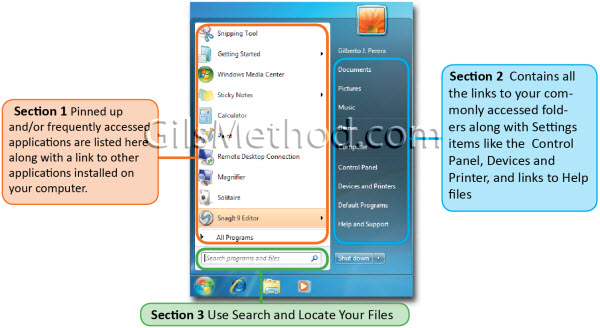
The Windows Start menu is comprised of three distinct sections, all providing you with easy access your files, applications, and settings.
- Section 1 – on the left contains the most frequently accessed applications with an option view all installed programs by clicking on the All Programs link.
- Section 2 – is made up of links to commonly used folders, files, settings, and other features.
- Section 3 – is the built-in search feature that allows you to locate any file or program on your computer within seconds.



The windows 7 star menu is great for the home user that does nothing but read email. For the rest of us it sucks.
Good job Microsoft, I $^& hate you guys. I am going home.
I’m afraid I will have to disagree with you on that one. The new Start menu offers so many options and it really does a great job of putting the things you use the most at your fingertips. If you want an overview of said features, please let me know. I’ll be more than happy to share them with you.
(This is the same David that replied earlier.)
I have to kind of agree with the original poster on this one. Right now I’m looking for a program I used yesterday, and it isn’t in the recently used programs list, as you would think it should be. The default opening of the menu seems like it should keep your recently used programs in it, and keep them sorted by how often they are used (I guess). The problem is that I have never been able to figure out the logic behind this ordering. Fundamentally, it *always* boils down to a searching operation for me, and that is frustrating and not really user-friendly when the number of programs exceeds six or so.
I love the ability to pin items to the taskbar. But as a power user, it isn’t enough.
Having written a book, created all of the graphics for it, and tuned the cover in Photoshop, as well as a bunch of other tasks (including currently working on creating videos for promotion), the list of programs I use is far to big. Liking organization, I keep the task bar auto-hidden on the left of the screen, and keep the desktop clean, with only a local weather widget on it and an icon for the recycle bin.
There is a bug in the explorer shell, or whatever it is that handles the task bar. If you have too many icons pinned to it, and it becomes two-columned, it sometimes doesn’t auto-unhide when the mouse is over the appropriate area when an app is full-screened. It just doesn’t work correctly. Also, I don’t really like the two-column approach.
So, I don’t consider the default task-bar behavior to be designed for real power-users. Because of this, I recently performed the hack to re-enable the quick launch bar, and that solves a huge problem, and I don’t have to search for programs nearly as much. (I make the width of the start bar to be three icons wide, so there are about 18 icons in it that I can quickly access.)
If MS made it so that I could toggle something (probably in the registry, although I hate the registry) so that the Start Menu opened up in “All Programs” mode, rather than recently used app mode, some of my frustration with the start menu would disappear. Also, keep the quick-launch, because that is very useful for true power users.
And yes, I know that typing in the start menu is a fast way to find programs–it just isn’t as fast as point-n-click, so I don’t use it.
Bottom line, the start menu is not as friendly as it could be for power users. I don’t think I’ve overlooked anything in its functioning, but if I have, let me know.
David
http://www.randommonkeyworks.com
ps – regarding the auto-hide ability – there is another bug in the processing of it. As I said, I have it set up to be three icons wide, but about 15% of the time when I come out of hibernation, or another mode (including complete reboots), this somehow resets to the default of one icon wide. This occurs whether or not the taskbar is locked. Come on, MS — get the everyday stuff right.
[...] The Star Menu button open the Start Menu previously discussed (see Get Around the Windows 7 Start Menu) [...]
I HATE the Win7 start menu, there's no way to organize programs into folders at the root level….very very frustrating. And why doesnt' the menu grow? Once you pic the max amount of programs your stuck having to go to All Programs which is a huge pain in the ass and slow to use. God to I hate the Wiin7 start menu in every way. Classic is much better.
@Eric – Have you tried pinning your favorite/frequently accessed programs to the Start Menu? This should help lessen the number of trips you make to the All Programs menu. Hope this helps.
Pavel: Don’t pin them. Just use Explorer to add directories off of “C:\ProgramData\Microsoft\Windows\Start Menu\Programsâ€? (Gil forgot the ‘Programs’ part) and move the existing shortcuts and subdirectories into your new ones. Then, when you hover or click “All Programs” in the Start window, your revised structure shows up. You will have to click through one UAC prompt for each move you make, but at least it gives you the structure you want, and once it’s done, it’s done.
Now, if MS would just do something about Search being so worthless in non-indexed areas… And every time I turn around, that’s where I need to find something… It used to work in XP–totally frustrating.
Sorry for the rant, but I hope this helps with the Start menu issue. It works for me.
@David – Thanks for the help with the answer….I did forget to mention the Programs on there. I do agree with you on the search of non-indexed items…maybe an update will fix that…we’ll see. Thanks again for the help.
I am looking for the same (I think) feature as Lary – custom folders (as Text, Graphics, Viewers, etc. containing sorted applications) in the Start menu which opens as a menu when you go with mouse over it.
Unfortunatelly, neither pinning the folders to the Start menu, nor the subfolders in “C:\ProgramData\Microsoft\Windows\Start Menu” does not help.
Clicking on a pinned folder opens the folder in a new explorer window, not as a menu.
A subfolder of “…\Start menu” is placed (strangelly) into “All Programs” list of the Start menu. Why? It get lost among too long list of all programs.
Is it possible to create custom lists similar to “All programs” placed at the left part of the Start menu?
I absolutely agree Larry. Its rubbish. What would have been the problem with letting the customer choose an XP/classic/Win7 menu? Its a pity as Win7 isn’t too bad. But the Start Menu is a biggie for me. Glad I downloaded it: I’m sticking with XP.
Maybe you can cut to the chase … ???
I use maybe 200 programs on a weekly basis that with the classic menu, I can group by folders: Graphics, Internet, Multimedia, Office & Utilities. With LONG filenames I don’t want, need or use search indexing. Ever.
The entire upper right portion of the win7 start menu was ONE link on my taskbar ! The bottom portion was all in another link called \Control Panel\ ! Duh… Which is another issue: columns get sorted VERTICALLY ! Ask ANY accountant or efficiency expert who does NOT work for MS… AND I always used the details view in EVERY explorer window, including control panel. Always. So How do I add what I want, not what the idiot microserfs want, to the start menu ? Or should I return/burn win7 and use an old pirated winXP64 and turn off ALL updates ?
@Larry – Are you talking about creating custom folders within the Start Menu so that you can group specific applications within those folders? If so – have you tried to browse the directory within Windows (C:ProgramDataMicrosoftWindowsStart Menu) this will help you create the folders within the Start Menu that I think you are referring to. If not – can you please clarify what you are referring to so that I can help you. Thanks for passing by. I look forward to helping you.
David,
Thanks for the valuable insight. Have you tried pinning the items to the Start Menu? I know that you use a great deal of applications as do I. The way I’ve been getting around it is by changing the size of the icons on the Start Menu which then allows you to pin up a large amount of icons before you start running out of space. Let me know if this works for you.
(Please remove the previous post of mine, as it appeared above your reply rather than below it. Your sequencer doesn’t properly organize posts by a 24 hour system, it seems, and I didn’t hit the proper ‘reply’ button.)
Yes, I have tried that. It isn’t as friendly, nor as quick, as re-enabling the quick launch bar, because you then have to remember which programs are on your start menu and which are on your task bar. With quick launch, you know that everything is on one place, and accessing it is just a simple mouse movement, whereas the method you propose requires remembering what is where, and an additional mouse click to access the start menu items.
MS probably used Fitts’s law to justify their decision to eliminate the quick launch, but googling reveals many others who have re-enabled it. I hope they re-enable it in future OSs, without the hiding that has been done in 7, because it is very useful. Fitts’s law doesn’t adequately model the entire situation in this instance.
And, as I said, I also hope that they make an option available to make the start menu open up in ‘All Programs’ mode. There, you always know where your programs are, and can have everything listed. Browsing my programs this way, I quickly count 72 that I use, some occasionally. And I don’t believe that is a complete list.
No problem…I took the duplicate out. Thanks for your feedback, I really hope you can find a solution to your problem. Maybe we’ll see a solution in Windows 8?